Products for Humans
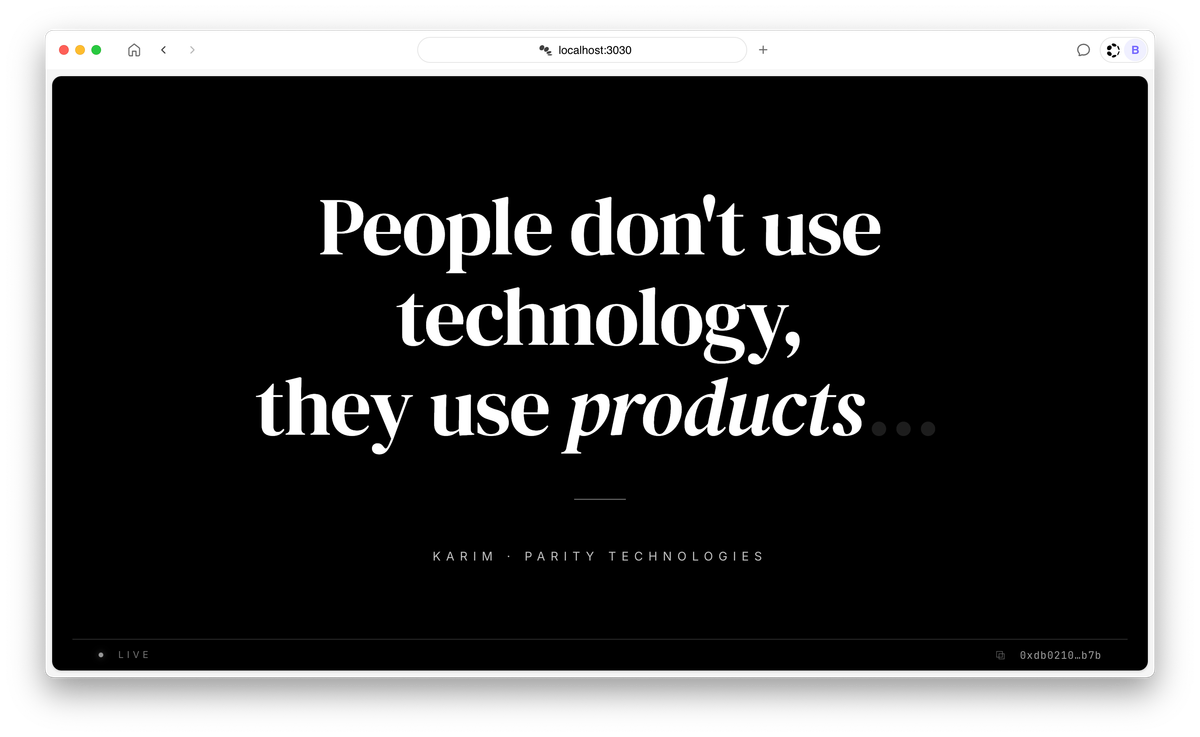
This talk was given at the Web3 Summit 2026, in Berlin, the 19th June 2026.
Watch it
If you were there in the room, you know I was real and that I gave that talk. If you're reading this, you have no such guarantee and that's more or less the whole point of the talk. So I did the obvious thing: this whole thing carries a signed receipt (down below). If you ever see a video of me saying something and there's no receipt attached, treat that as a reason to be suspicious, not as proof of anything. More on why that distinction matters later.
Also, yes, the demo glitched at the start. It always does. It came back.
Slides
The signed receipt
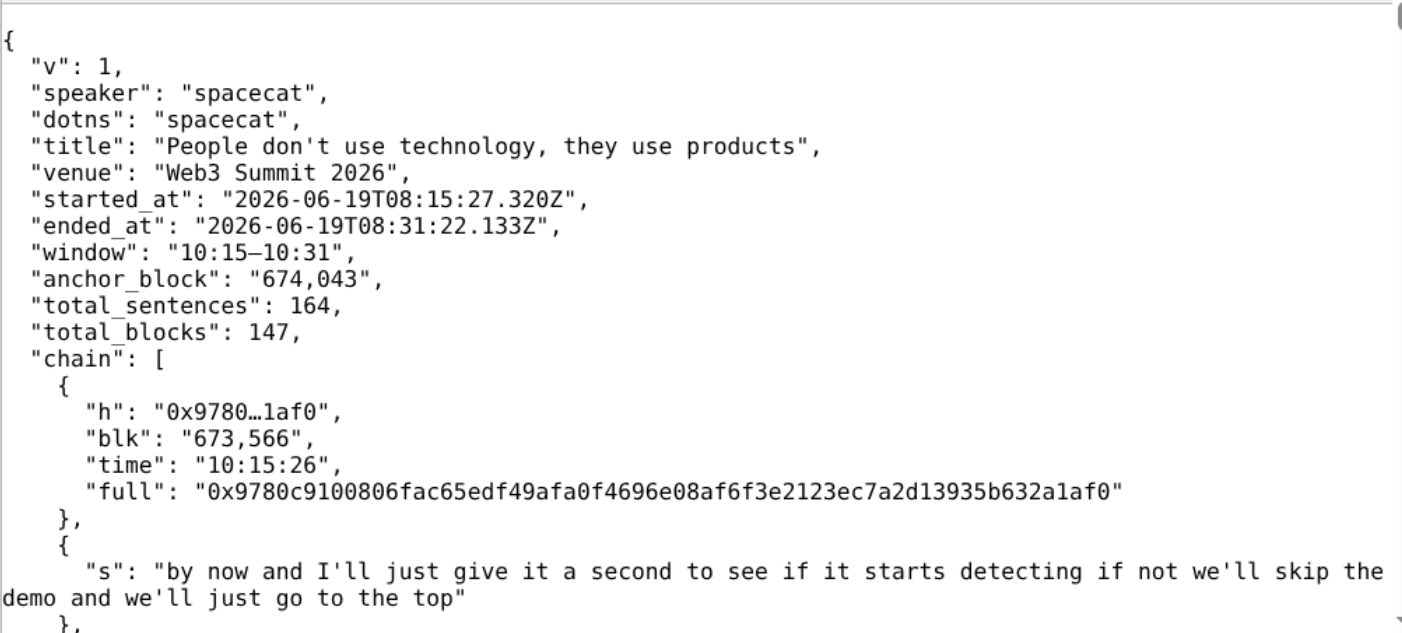
While I was talking, my speech was transcribed in real time using whisper, and block hashes from the network were embedded into that transcript as it went. At the end I signed the whole thing with Polkadot Mobile key. The receipt below tells you three things: this talk happened that morning, these were the exact words that were said, and one verified unique human, me, under the username spacecat gave it. You can find the JSON here: https://blog.jedda.eu/bafybeiaagh44lqgz64g5ccnde454yxeqgrspl32klxafdfrj3jz55ag35i/artifact.json
Now during the talk, the audience wasn't shown the raw JSON, but rather, they could scan the QR code that was generated to "seal" the talk using their Polkadot Mobile app (released on an ephemeral Summit network) to display the proof of the talk and verify it independently.
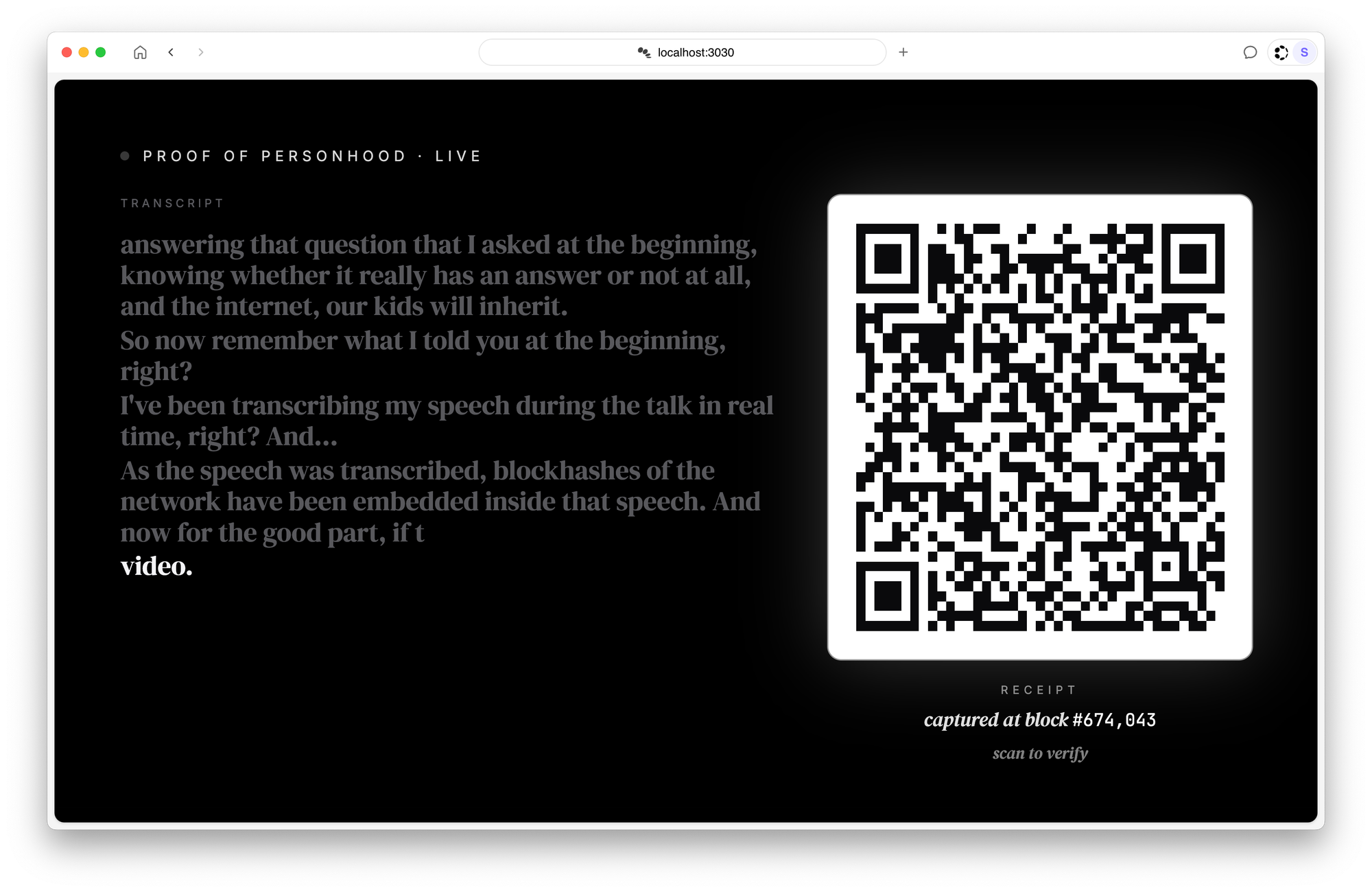
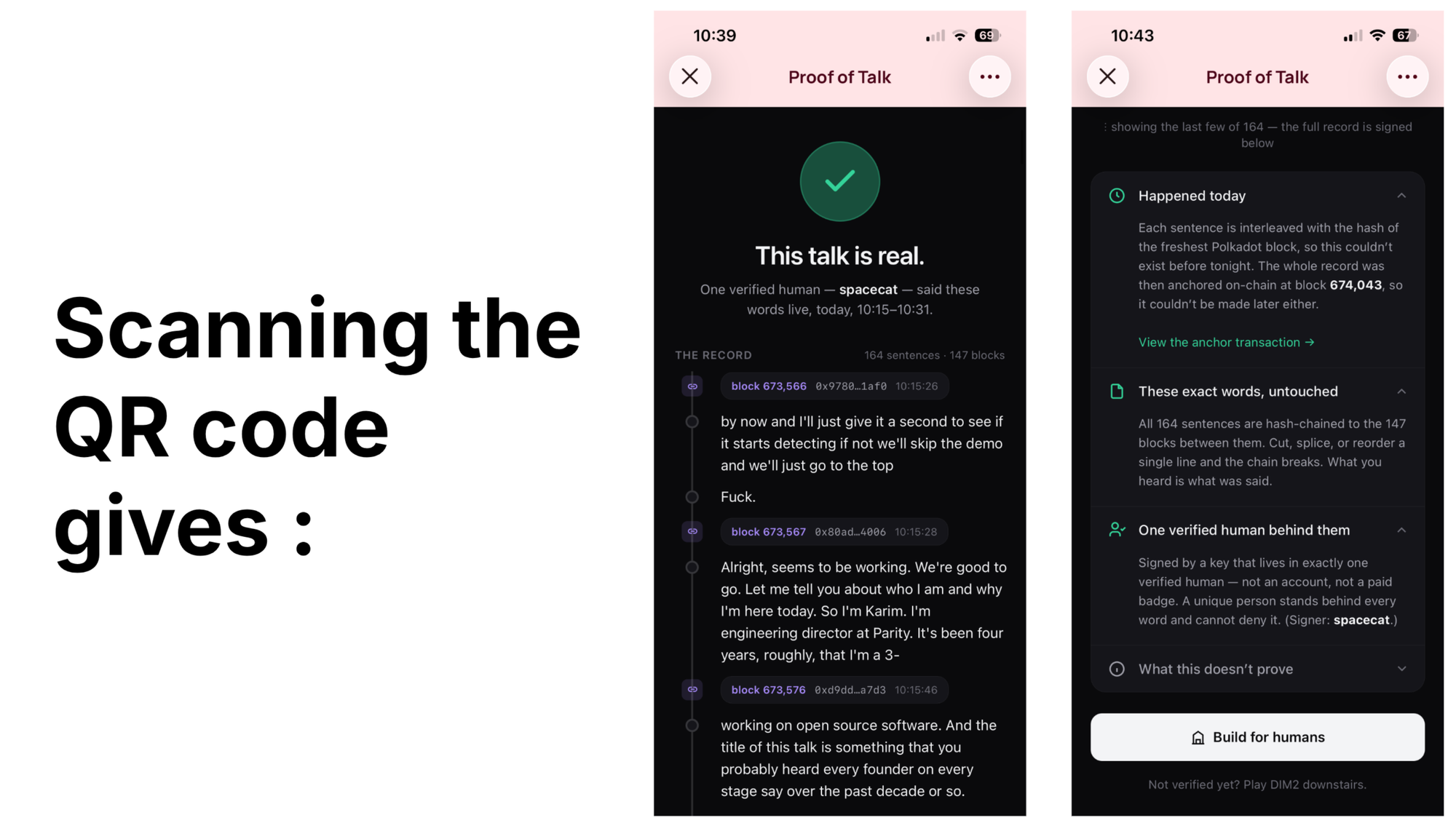
Note: Scanning the QR code will work once the Polkadot Mobile app is live and available to everyone.
If you like to understand how the code was setup, you can inspect it and try it out here: https://code.jedda.eu/proof-of-talk/doc/tip/README.md
The recap of the talk
I'll keep this to the shape of the talk. Three parts: how the internet is losing its humans, the thing we built at Parity to do something about it, and what I'm hoping you'll go build with it.
The internet is losing its humans
I spent a big part of my career on big data, building machines that collect data, turn it into datasets, turn those into segments about people, and feed all of that into recommendation algorithms. I was good at it. But recommendations were never the end of the line. All that data now trains language models, voice models, image models. ChatGPT, Midjourney and the likes. These are genuine miracles, and they write and speak like you and me because they were trained on data made by you and me.
So the machine that collects human data and the machine that imitates humans are, essentially, the same machine. Data comes in, models go out. And that machine now generates content faster than we can verify it. We're at a tipping point where the main inhabitant of the web stops being a human and starts being a bot, not the dumb spam bots of ten years ago, but agents that hold real conversations, wear faces of people who may or may not exist, and pass every test we've built to catch them.
Which leaves us with one question that I think we'll be asking more and more: can you trust what you're seeing on screen? Is there a human behind these words?
The centralized platforms won't save us here. Not because they're evil but because of what they are. I think of a platform as a database tuned in real time by algorithms to drive engagement. To that database, a bot and a human look identical, and it'll happily show you either one if it keeps you scrolling. And you can't ask a company whose stock price rides on active-user counts to be your honest counter of humans.
Every trust signal we built for this is breaking. Check marks, follower counts, star ratings etc, you can buy all of it for a few dollars in a few minutes. My colleague Ian told me about a restaurant in the UK that got very popular and turned out not to exist at all: someone invented it, bought the ratings and the followers, the whole thing was an experiment to show how fragile our signals are.
To be clear, the problem is not that a machine wrote something. I use AI every day and full disclosure, I used it to prepare this talk, I use it to code. The problem is when a handful of actors can make it look like there are many, and we read "many people agree" as something we can trust. There's the finance worker in Hong Kong who got asked by his CFO to wire 25 million. Protocol said he needed visual confirmation, so they got on a video call, everyone confirmed, and he sent it. Every single person on that call was a deepfake.
Here's the hopeful part, though: we've beaten a version of this before. Email was a miracle too, and then spam took over something like 90% of the traffic. Filtering the content of messages wasn't enough. What turned the tide was origin auditing, meaning that we stopped only asking "what does this message say" and started asking "who sent this, and can they cheaply send a flood of them", plus reputation on top. That made email usable again. Spam never vanished. It just stopped being free.
That's the lesson I keep coming back to: you can't make truth unfakeable. That will always be possible. What you can do is make distributing fakes expensive again.
What we built
Email is one system, though. What about something that works across all of them? At Parity we built the tech for cryptographic proof of personhood. We call it Humanity. It's a way for a screen to ask "is there exactly one unique human here?" and a way for another human to check that independently, without trusting a third party.
I think of it as authentication infrastructure ie a way to authenticate someone without identifying them. The analogy is Apple Pay: when you tap, the merchant knows the payment went through, but not your name, not your bank account, nothing. Same idea here. Tap, and the machine knows you're one authenticated human. Not who you are. One human, not identified. That difference is the entire game.
The system is flexible. It supports multiple decentralized identity modules, DIMs, for different use cases. At the Web3 Summit, we played DIM 2: a little social game where other people verify whether you're a real human, which produces a mathematical proof of individuality tied to a key.
Now, the record of which key belongs to a unique human has to live somewhere. A central database of verified humans is far too dangerous for a single company to own. This is where decentralization earns its place: not as a synonym for freedom, but as a strict security requirement. Humanity only means something if no central authority can quietly print more humans. So it has to be built on open, neutral protocols that anyone can plug into, like HTTP. We built it on Polkadot, where no single entity can shut it off, raise the gates, or change the rules on its own.
One aside, even though I promised this wasn't a UX talk: technology that works can still be shipped the wrong way. We used to onboard people with a seed phrase: a string of words holding the secret to your key. Powerful, and completely wrong for a normal person. Store it safely, never lose it, and if you do, it's all over. The new app hides that. Good tech only matters if it's delivered in a way people can actually use correctly.
What I want you to build
Which brings me to the sentence everyone's been saying for a decade: people don't use technology, they use products. I said it too, and I believe it. But I think two words are missing. It should be products for humans.
I mean it in two ways. Products for humans to use, no seed phrases, no needless complexity. And products for humans to be human, where a person can prove they're a person and still stay private. Most of the industry has the first part and is getting the second part badly wrong: asking people to send videos of themselves to centralized servers to register for things. The companies that get both right, technology wrapped well, and built for humans will win the next twenty years.
Web2 is becoming the bot web. It's carved into silos each platform controls, with no shared authentication layer to bind them. We can make Web3 the human web instead? A layer that proves the internet is still made of humans, and that it was made for them.
The cryptography works. You can use it today. The privacy proofs exist. What doesn't exist yet is the products. So that's the ask: build them for humans, build them for outcomes that matter, and build them on ground no one owns... because that's what keeps the whole thing from being captured by a political power later. The stake isn't a market. It's whether that opening question even has an answer in the internet our kids inherit.
FAQ
I've started adding one of these to my talks. The press-release bit up top is the version I'd want on the record. The FAQ underneath is the harder half... the questions I'd ask if I were watching the video trying to poke holes. I'd rather answer them here than pretend they don't exist.
I scan the QR code but I see nothing
Scanning the QR code should work once the Polkadot Mobile app is live, as it leverages it. Meanwhile, I've saved both the signed receipt https://blog.jedda.eu/bafybeiaagh44lqgz64g5ccnde454yxeqgrspl32klxafdfrj3jz55ag35i/artifact.json as well as the code https://code.jedda.eu/proof-of-talk/doc/tip/README.md which should let you independently verify that the signature is correct.
Does the signed receipt prove that what I said is true?
No and it's not trying to. A receipt proves attribution: one accountable, verified human stood behind these exact words at this time. That's a different thing from truth. A real person can sign a real lie, and the receipt won't stop them. What it removes is the cheap version of the attack: the flood of fabricated voices that only looks like agreement. It doesn't hand you truth but the thing truth has to stand on: attribution you can't fake for free.
You said "no receipt means it's AI." But almost everything real is unsigned too, doesn't that break the claim?
Fair hit, and I want to be precise about it, because on stage I said it as a punchline. Absence of a receipt is not a law of physics that says "this is fake". Most genuine content in the world will never be signed, and that's fine. The claim is narrower: for the things that actually matter: a talk, an official statement, a video attributed to a named person, signing can become the default, and once it's the default, its absence is a reason to lower your confidence, not to conclude forgery. Missing receipt should move you toward "I can't confirm this" and not "this is fake". I'd rather state it that way than oversell it.